显示标签为“dollar”的博文。显示所有博文

2017/01/03

Donald Trump: China's Dark Days Is Coming

Donald Trump talks directly tough on China issues after appointing trade hawks Wilbur Ross and Peter Navarro to key positions in his administration. He even threatened to slap a blanket tariff on Chinese goods and talked to Taiwan's president, which was regarded as a big diplomatic offense.
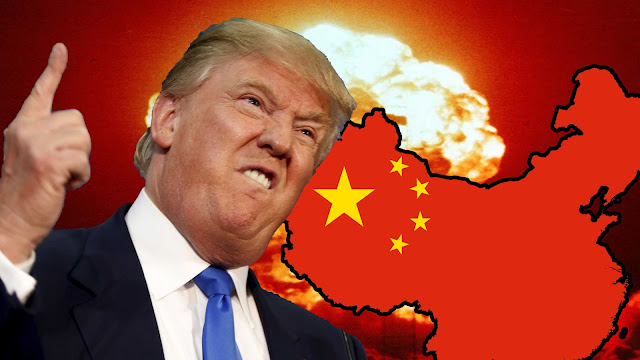

Donald Trump, Trade War

This is just how Trump opens the “China negotiations” to reach a mutually beneficial trade relationship, according to "Road to Ruin" author James Rickards.

    
"[Trump] is saying to China: 'Here is where we are going to start, what have you got for us? Are you willing to be more flexible on foreign direct investment, are you willing to treat U.S. companies in China more fairly, are you willing to stop the theft of intellectual property?' If The world factory makes concessions on these points he can say, 'Fine, now my tariff is [lower].' It's the art of the deal; people don't understand that about Trump," Rickards told the BBC.
In any deal, however the other party has some negotiating chips on the table as well, and China, for instance, can hurt American companies exporting to China or American companies operating in China.
So who will lead the negotiations? A report by research firm Geopolitical Futures (GPF), the United States would suffer some loss in the trade war, but would lead the situation in the end.
"China would feel the impact of U.S. protectionist measures more than the U.S. would feel any economic retaliation China has at its disposal," the report states.
What's at Stake?
The most essential point for US and China is the symbiotic relationship between China the exporter and the United States the importer. Between Chinese workers who make cheap goods and U.S. consumers who purchase them.
United States imported $483 billion worth of goods from China in 2015. Since China joined the WTO in 2001, the States was the top importer of Chinese goods in all but one year.
An interesting experiment shows, about 15 million Chinese workers in the export sector could lose their jobs if Americans stopped importing from China altogether - a nightmare for the Chinese regime, which depends on employment to keep the people happy and itself in power.
So will the US companies doing business in China can still benefit a lot? They have to face the pressure from the environment, the rate, and the policy. My friend who was working in a Shanghai company told me of his problems of finding the good suppliers with healthy credit score.
May you spend a tea time to anticipate the investigation below here ?

Focus on:
We, eGTCP, welcome you to applying for GTCP(Great Tao credit purchasing card), you can get $10,000 immediately, buy more, pay later, let's get started!

credit card,credit purchasing card, credit purchasing


Follow us:
  
Like eGTCP on Facebook. Follow eGTCP on Linkedin. Follow eGTCP on Google+. Follow eGTCP on Twitter. Visit eGTCP on Youtube.                                                        


2016/12/20

The Key to Keep Your Business Strong as China Devalues Yuan

China's currency RMB fell to its lowest level against broadly stronger US dollar in eight plus years on Thursday after the Federal reserve raised interest rates.

Traders spoke China's central bank set a stronger yuan midpoint than expected to counter market expectations for a faster depreciation, with big state-owned banks also supporting the yuan by offering dollars.

The People's Bank of China set the midpoint rate at 6.9289 yuan per dollar prior to market open, weaker than the previous fix 6.9028, report says.

China Yuan, dollar, RMB, interest rate, money
image from internet

269 pips weaker than the previous late session close and 0.07 percent weaker than the midpoint as the spot market opened at 6.9350 yuan per dollar and traded at 6.9339 at midday.
A trader at a Chinese bank in Shanghai said "Demand to buy dollars is quite strong today, but big Chinese banks are offering large amount of dollars around 6.9340 area to avoid the yuan from falling too much".

The U.S. central bank raised the target federal funds rate by 25 basis points to between 0.50 percent and 0.75 percent in a closely watched decision on late Wednesday, but the fact was Federal Open Market Committee members for a median of three more hikes in 2017, up from two previously, driving the dollar higher.

Ngan Kim Man, deputy head of treasury at China Everbright Bank's Hong Kong branch, said tight liquidity in the offshore yuan market was normal seen from a year-end trend, but Beijing's recent measures to manage capital outflows had made it much more expensive to shorten the yuan.

In the past few weeks, has the interbank borrowing rate in the offshore yuan market been elevated . The overnight borrowing rate was fixed at 11.76 percent on Thursday, much higher than 7.32233 percent on Wednesday.
Analysts add liquidity is generally tight towards the-year-end, especially amid a plunge of government bonds.
When Yuan weakens, have you come up with an appropriate solution to keep your business in China still valuable. eGTCP is here to offer one-stop services, such as credit card, credit assurance, order matching, logistic service and supply finding.


Follow us:

  
 Like eGTCP on Facebook. Follow eGTCP on Linkedin. Follow eGTCP on Google+. Follow eGTCP on Twitter. Visit eGTCP on Youtube.                 


2016/11/24

China weakens yuan - dollar rate below 6.9 for the first time

It is reported China has weakened the yuan's reference rate to beyond 6.9 to the dollar for the first time ever in more than eight years on Thursday.
According to data from the Foreign Exchange Trade System, the People’s Bank of China set the value of the yuan (RMB) to 6.9085 to the dollar, down 0.26% from last day’s fixing. 
The dollar rose to 14 years’ highest as markets expect the US Federal Reserve to hike interest rates next month.
image for internet

On either side of the daily fix, China only allows the yuan to rise or fall two percent, which is one of the ways CCP maintains control over the currency.
The yuan weakened for 12 consecutive sessions up to & including Monday, and Thursday’s level was the lowest one since the summer of 2008.
"There are no fundamental reasons for CNY to do anything other than weaken," Michael Every, head of Asia-Pacific financial markets research at Rabobank, told AFP, referring to the onshore yuan quote.
"Growth is artificially supported by unsustainable state spending and borrowing; there are still major capital outflows; the USD is firming; rates are about to be raised in the US; and China could be negatively impacted by tariffs as soon as 20 January."
US President-elect Donald Trump promised to declare China during his campaign a currency manipulator on his first office day, and threatened to slap 45 percent punitive tariffs on Chinese imports to protect US jobs.
According to the Foreign Exchange Trade System, the onshore yuan was quoted at 6.9194 in late morning trading on Thursday, down 0.39 percent from Wednesday’s close of 6.8928. 
In August of 2015, Beijing suddenly devalued the yuan, which caused investors to dump the unit in volumes not seen since 1994 and sparking an outflow of capital from China.
As the yuan is devaluing, investment in mainland China seems unpromising at present. So, can credit purchasing be the next trend?
Focus on:


We, eGTCP, welcome you to applying for GTCP(Great Tao credit purchasing card), you can get $10,000 immediately, buy more, pay later, let's get started!
credit card,credit purchasing card, credit purchasing
Follow us:


 Like eGTCP on Facebook. Follow eGTCP on Linkedin. Follow eGTCP on Google+. Follow eGTCP on Twitter. Visit eGTCP on Youtube.